Introducing Checkup GPT
Checkup GPT is a free AI portfolio analyzer: enter what you hold and your goal to see your score, fund fees, overlap and a crash test in about 20 seconds.
Posted by
 Rawee Kambhiranond
Related reading
Income GPT builds an income portfolio from savings, CDs, bonds, dividend stocks and REITs, with live yields and an estimate of what each holding pays.
AI GPT builds a portfolio of AI stocks or ETFs from 22 themes, from chips and cloud to the power grid and data centers that AI runs on.
Index GPT builds a personalized index fund portfolio from your goals, spanning the S&P 500, NASDAQ, Europe, Asia and India. See how it works.
Checkup GPT is an AI portfolio analyzer that reviews the investments you already own. Every other PortfolioGPT tool builds a new portfolio; Checkup GPT starts from yours. Enter your holdings and the dollar amount in each, tell it your goal, time horizon and risk level, and in about 20 seconds it returns a score out of 100, your mix compared with your goal, what your funds cost, where they overlap, how the mix held up in past market drops and a backtest against the S&P 500.
What's new: Checkup GPT is now open in beta in the Playground section of your dashboard. It's part of PortfolioGPT, and it checks stocks, ETFs and mutual funds alike. For a step-by-step walkthrough with screenshots and video, read Getting Started with Checkup GPT.
Educational content, not financial advice. Checkup GPT shows ideas to consider; you decide what to do with your money.
🩺 Why Check the Portfolio You Already Have
Most portfolios aren't built in one sitting. A fund from a 401(k) rollover, a few stocks bought on a tip, an S&P 500 ETF added later: over time the pieces can drift away from what you're investing for. A checkup answers the questions that are hard to see from a brokerage screen:
- Does my mix fit my goal? A retirement portfolio 10+ years out and a fund for a home purchase in 3 years need very different amounts of stocks and bonds.
- Am I more concentrated than I think? If you own Apple directly and through two index funds, your real Apple position is bigger than the line in your account.
- Are my funds paying for the same thing twice? Funds that track similar indexes can hold many of the same companies.
- What am I paying? Every fund charges an expense ratio, an annual fee taken as a percentage of your money (Investor.gov). A cheaper fund that tracks the same index keeps more of the return for you.
- How would this mix handle a bad year? Seeing how it did in past drops is a practical way to check your risk tolerance.
🔍 What Checkup GPT Checks
Checkup GPT runs eight steps on every portfolio: it looks up your holdings with live prices, compares your mix to your goal, checks fund fees, looks for overlap, finds where your money is by sector and region, replays past market drops, backtests against the S&P 500 and writes your review. The examples below come from a sample checkup of a $1,000 portfolio (VOO $400, QQQ $250, AAPL $200 and GLD $150) for retirement, 10+ years, at medium risk, run in November 2026.
💯 Your Checkup Score
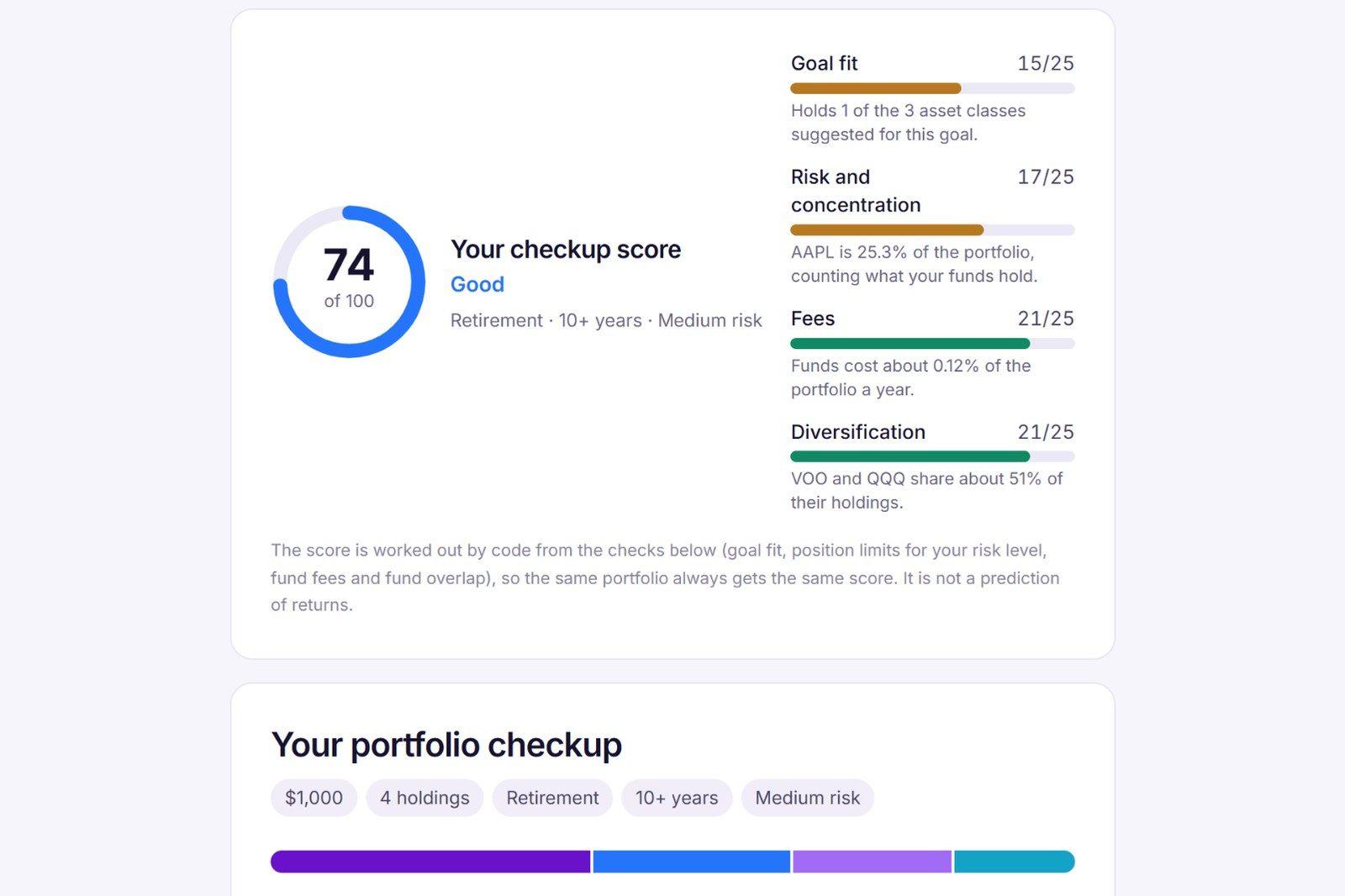
The score is out of 100, in four parts worth 25 points each: goal fit, risk and concentration, fees, and diversification. Each part shows the reason behind its points. The score is worked out by code from the checks, not by the AI, so the same portfolio always gets the same score, and it is not a prediction of returns. The sample portfolio scored 74 (Good): it lost points on goal fit because it holds no bonds, and on concentration because Apple was 25.3% of the portfolio once its funds were counted.
🎯 Your Mix vs. Your Goal
Checkup GPT sorts your holdings into stocks, funds, bonds, cash, real estate, commodities and crypto, then splits them into growth assets and steady assets. It compares that split with PortfolioGPT's target for your goal, horizon and risk, and lists the asset classes suggested for your goal that you don't hold yet. For the sample retirement portfolio, growth assets were 100% against a target of 60 to 70%, and bonds were missing. To see how horizon shapes that target, read our guide to investment time horizon.
💸 Fund Fees and Cheaper Twins
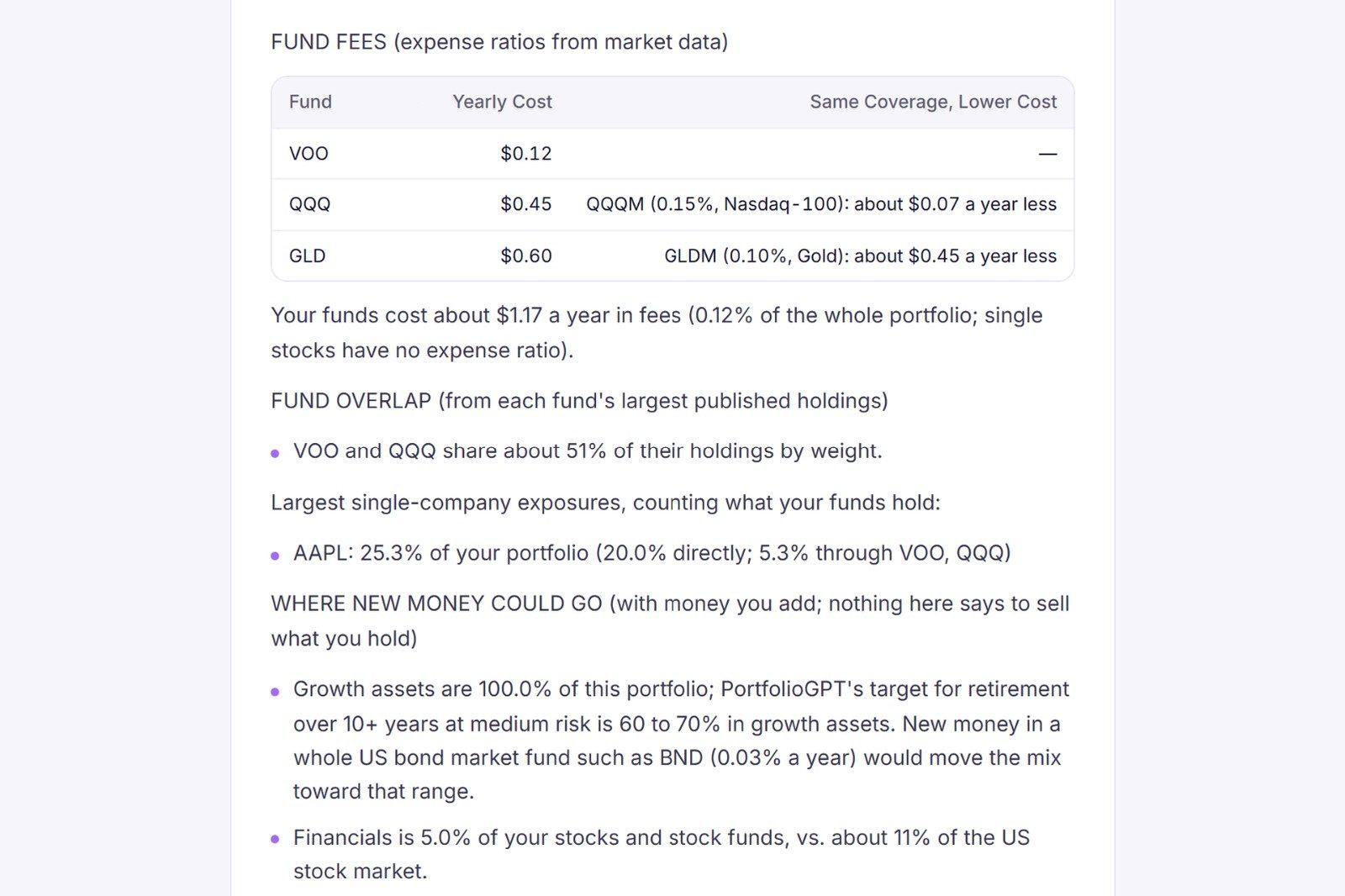
For each fund, Checkup GPT shows its yearly cost in dollars from its expense ratio and, where one exists, a cheaper fund that tracks the same index. In the sample, the funds cost about $1.17 a year in total (0.12% of the portfolio; single stocks have no expense ratio), and it pointed to QQQM for the Nasdaq-100 and GLDM for gold as lower-cost twins. If you want low-cost index funds from the start, Index GPT builds a portfolio from them.
🔁 Fund Overlap and Hidden Concentration
Checkup GPT compares each fund's largest published holdings to show how much your funds overlap, then adds up your largest single-company exposures across everything you own. In the sample, VOO and QQQ shared about 51% of their holdings by weight, and Apple was 25.3% of the portfolio: 20.0% held directly and 5.3% through the two funds.
🗺️ Sectors and US vs. International
Counting what your funds hold, Checkup GPT shows your stocks by sector next to the US stock market (the sector mix of a total US market fund) and splits them between US and international. The sample was 56.6% technology, against about 35% for the US market, and 100% US.
📉 Crash Test and Backtest
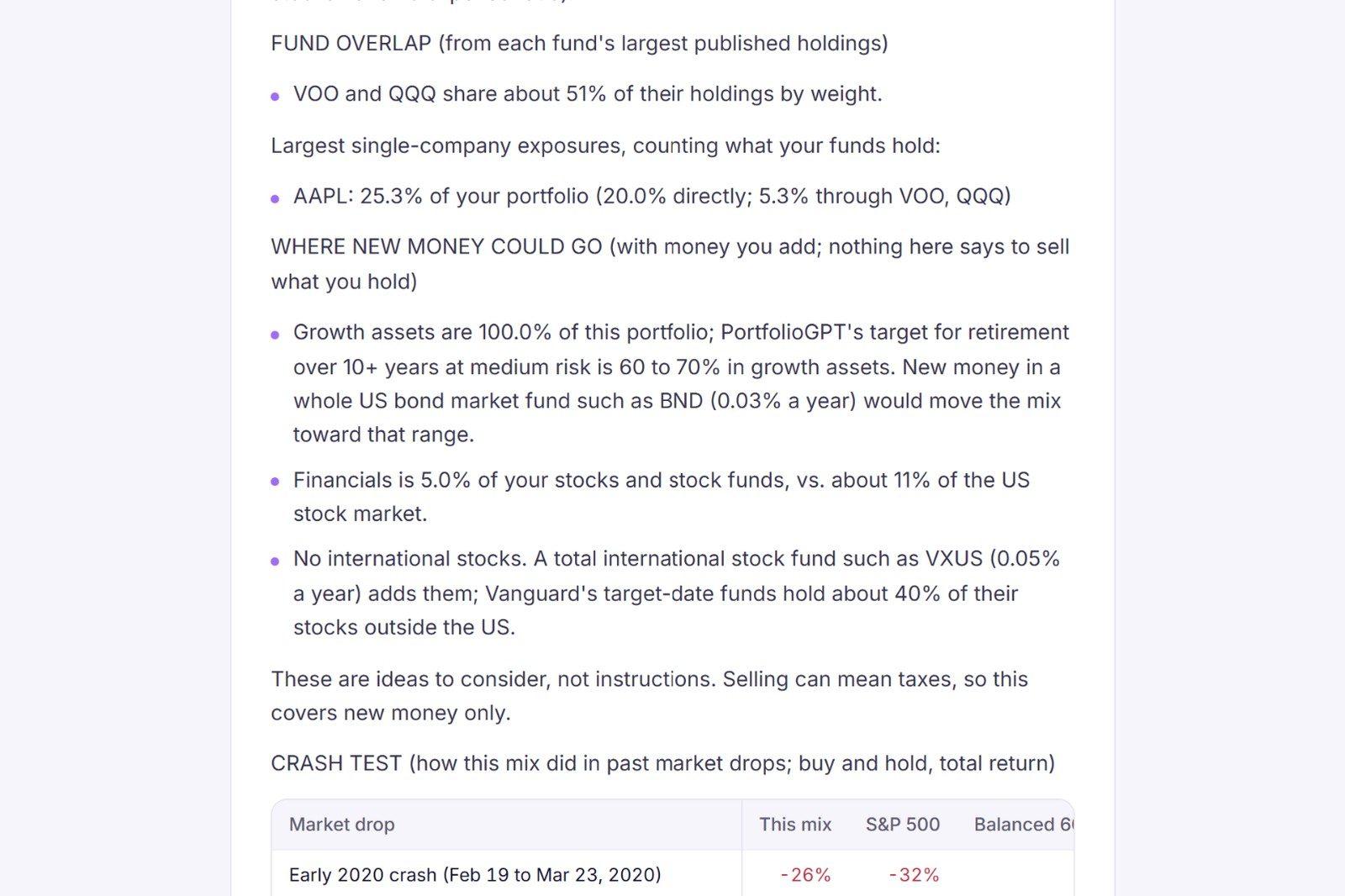
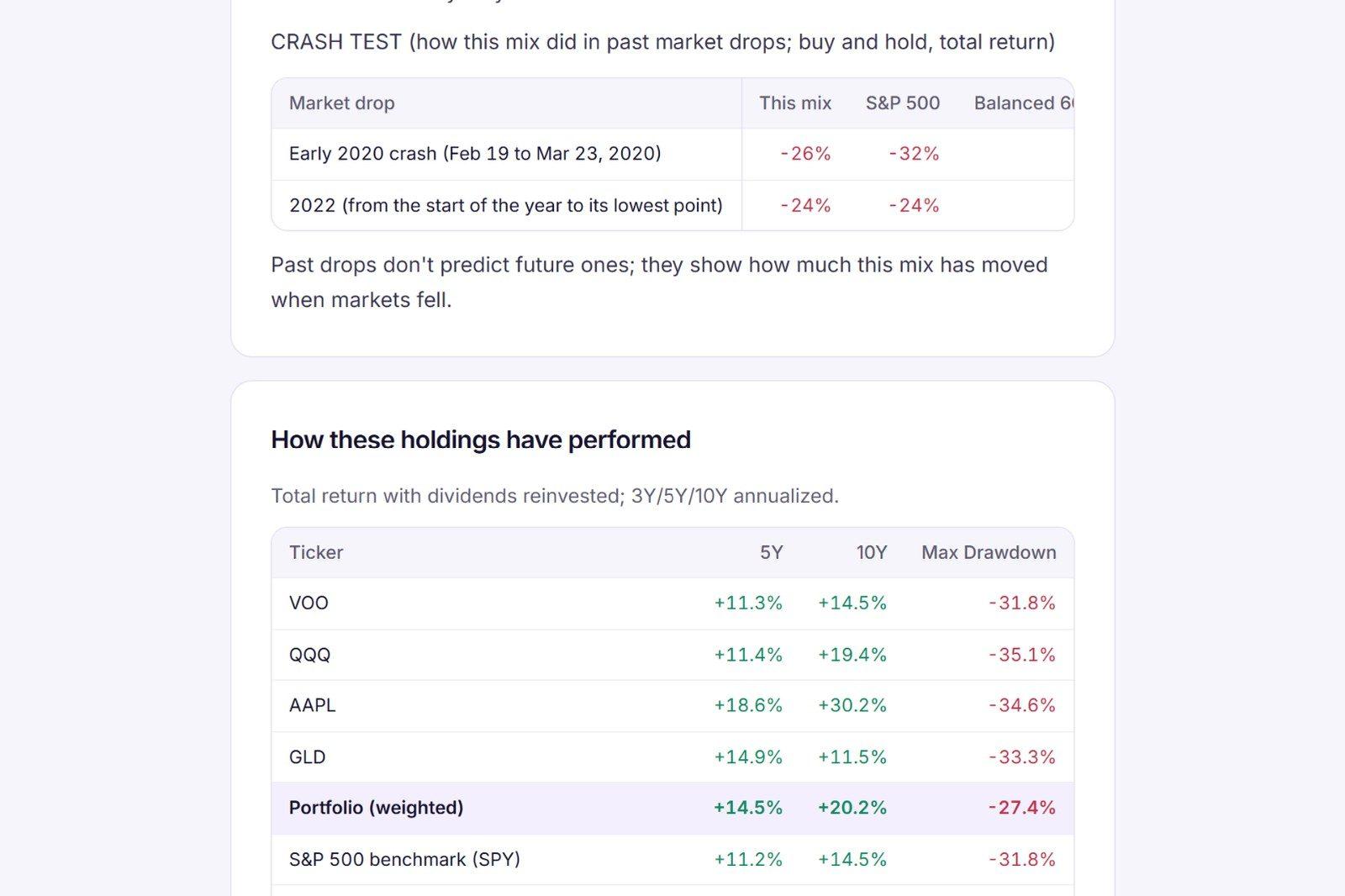
The crash test replays two market drops with buy-and-hold total returns: the early 2020 crash (February 19 to March 23, 2020) and 2022, from the start of the year to its lowest point. The sample mix fell 26% in early 2020, when the S&P 500 fell 32%, and 24% in 2022, the same as the S&P 500. A performance table then shows each holding's 5- and 10-year annualized total return with dividends reinvested and its maximum drawdown, next to the S&P 500. Past drops don't predict future ones; they show how much a mix has moved when markets fell.
➕ Where New Money Could Go
The review ends with what's working, what to consider and where new money could go, such as a total bond market fund to bring a growth-heavy mix toward its target. Checkup GPT covers new money only and never tells you to sell, because selling can mean taxes. When a deeper look would help, it points you to Income GPT, Retirement GPT or Real Estate GPT.
⚙️ How Checkup GPT Works
Checkup GPT looks up live prices from Tickerbot and Yahoo! Finance, then works out the numbers from market data: the asset mix, expense ratios from market data, overlap from each fund's largest published holdings, sector and region weights, the crash test and the backtest. The score comes from those checks. AI then writes the review in plain English from those numbers. You can type a ticker or a fund or company name, and mutual fund tickers work too. The checkup needs at least $100 in total.
Your checkup can be emailed to you, and it's saved like any PortfolioGPT portfolio: on Pro, to your account on any device; on the Free plan, your 5 most recent stay on the device you used.
🆓 Checkup GPT on Free and Pro
On the Free plan, Checkup GPT checks up to 8 holdings, your largest ones, and each checkup counts toward the 5 free runs a day shared by PortfolioGPT's tools. Pro costs $3 a month or $27 a year and checks up to 25 holdings, with no ads and no daily limit. Pro can also fill in your holdings for you: paste a positions list, or upload a CSV or a screenshot from your brokerage. PortfolioGPT reads it once to fill in your rows and doesn't save it.
🚀 Get Started with Checkup GPT
Checkup GPT is designed to help you understand the portfolio you have, not to replace professional advice. Its suggestions are ideas to consider, not instructions; do your own research or talk to a certified financial planner before making big changes.
💡 Ready to see how your portfolio scores? Gather your holdings and the dollar amount in each, and your checkup arrives in about 20 seconds. Open Checkup GPT, or follow the step-by-step guide.
FAQ
What is a portfolio checkup?
A portfolio checkup is a review of the investments you already own against your goal, time horizon and risk level. It looks at your mix of assets, what your funds cost, how much your funds overlap and how concentrated you are in single companies or sectors. Checkup GPT runs these checks in about 20 seconds and explains the results in plain English.
Will Checkup GPT tell me to sell anything?
No. Checkup GPT shows what's working and what to consider, and its suggestions cover only where new money could go. Selling can mean taxes, so the checkup never tells you to sell what you hold. Its ideas are educational, not instructions.
What is ETF overlap?
ETF overlap is how much two funds hold the same companies. For example, an S&P 500 fund and a Nasdaq-100 fund both hold Apple, Microsoft and NVIDIA, so owning both doubles up on those stocks. Checkup GPT measures overlap from each fund's largest published holdings and counts what your funds hold when it shows your biggest single-company exposures.
Is Checkup GPT free?
Yes. On PortfolioGPT's Free plan you can check up to 8 holdings, within the 5 free runs a day shared by the tools, with no credit card. Pro costs $3 a month or $27 a year and checks up to 25 holdings, fills in your rows from a pasted list, a CSV or a screenshot, and removes ads and the daily limit.